Stochastic Process
based on the lecture: Syllabus | Topics in Mathematics with Applications in Finance | Mathematics | MIT OpenCourseWare
A Stochastic Process is a collection of random variables indexed by time.
We have two types of these processes, discrete-time processes and continuous-time processes.
Note that the function which represents a continuous-time stochastic process itself does not need to be a continuous time, rather it just means there is an uncountable number of random variables indexed by time.
Alternate Definition
A Stochastic Process is a probability distribution over a space of paths.
Examples
Example 1
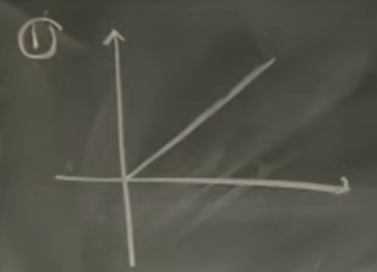
This is a straight forward example, where it’s just a single deterministic path.
Example 2
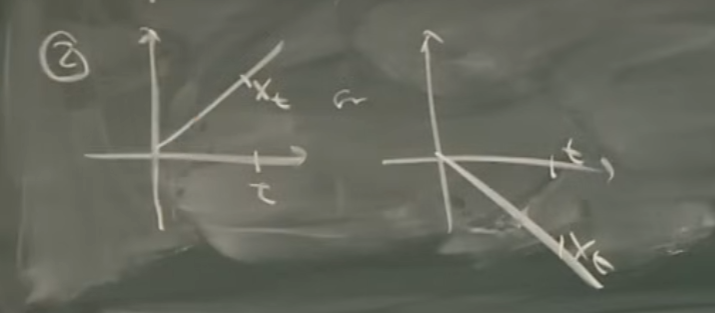
This example has two possible paths, one where the function increases linearly and another where it decreases linearly, each with equal probability. Like a coin flip, we can think of this stochastic process as randomly selecting one of these two paths at the start and following it through time.
Example 3
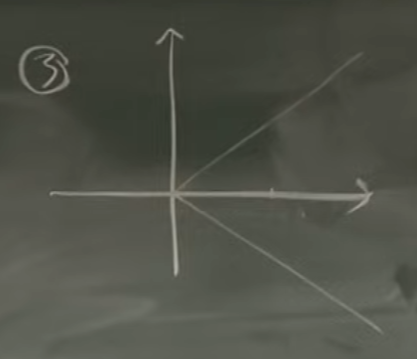
This last one, you can imagine two translucent lines, one at the other at , and at each time step, the stochastic process randomly selects one of these two lines to be on. Over time, this results in a zig-zagging path that jumps between the two lines at each time step an infinite number of times.