Classic Disruption
A classic disruption is a type of disruptive innovation which refers to situations where a new entrant targets overlooked segments with a simpler, more affordable solution, eventually moving upmarket to challenge established players.
Definition
A classic disruption is characterized by the following 4 points:
- Entry from the low-end or a new market:
- Disruptors begin by serving overlooked customer segments (low-end disruption) OR
- Creating a market among non-consumers (new-market disruption)
- Early inferiority and incumbent neglect
- The early offering is inferior on mainstream performance metrics, so incumbent dismiss it.
- The entrant’s early customers are not the incumbent’s most profitable.
- Incumbents focus on improving performance for demanding customers.
- Technology advancement drives climb
- Fast technology advancement drives upmarket climb.
- Once “good enough,” they unlock entrant expansion into mainstream and high-end markets.
- Incumbent inability to adopt
- Incumbents face organizational and business model constraints that make it hard to invest in disruptive innovations.
- Resource allocation favors high-margin legacy products, not early-stage disruptive alternatives.
- Once the incumbent responds, usually once the entrant enters the mainstream, it is too late, as the disruptor is already on the exponential part of the S-curve.
Analysis
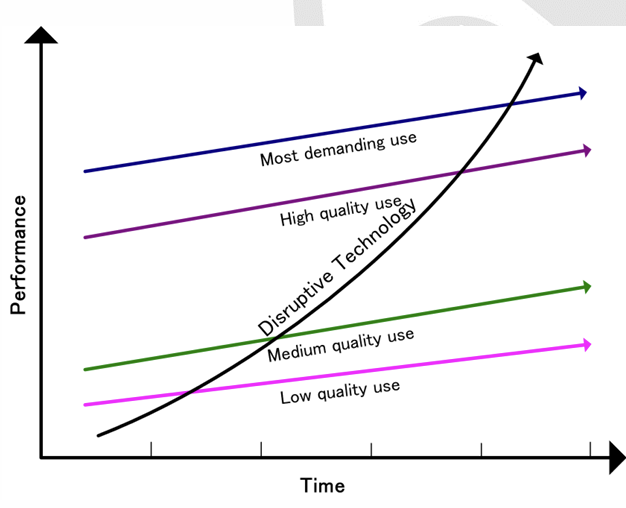
Most new technologies need time to develop, that is, it takes resources, investment, and development to create them. That is why, at the beginning, the incumbent often neglect these new ideas. They’re slow to grow, have few or no customers (possible due to network effects), and are often inferior to existing solutions. As such, incumbents don’t see them as a threat.
But once they finish this slow period, they reach exponential growth. At such time, if the incumbent tries to take action, they have the begin at that slow part again, basically, it’s already too late.